
'%20d='m0%200%2016%2011h61%2061%2061%2061%2060L47%2037h61%2061%2060%2061L16%2063h61%2061%2061%2061%2060L47%2089h61%2061%2060%2061L16%20115h61%2061%2061%2061%2060L47%20141h61%2061%2060%2061L16%20166h61%2061%2061%2061%2060L47%20192h61%2061%2060%2061L16%20218h61%2061%2061%2061%2060L0%200'/%3e%3c/svg%3e)

Article overview
Dustin’s October 2026 store visit connects brand displays in Spain with 2025 European retail results and China’s appliance export data through June 2026.
During my visit to an appliance store in Spain on 10 October 2026, I photographed air fryers, blenders and a coordinated countertop range. What stood out was the variety of ways to sell a familiar appliance: family capacity, a view of the food, or a consistent look across the kitchen. For European buyers sourcing from China, these are useful starting points for a product brief.
The wider data point to selective growth. Cleaning appliances are gaining momentum, while air fryers are moving beyond their initial boom. The purchasing opportunity is to match a clear household task with the right specification, finish and support package.
What the Spanish shelves reveal
The photographs show several approaches sharing the same retail space. I would use them as separate benchmarks when developing a range.
| Brand in the photographs | Visible product approach | Question for a sourcing brief |
|---|---|---|
| Moulinex | Easy Fry Mega packaging highlights a 7.5-litre basket and family meals; a blender sits alongside it. | What usable capacity and cooking result can the product demonstrate? |
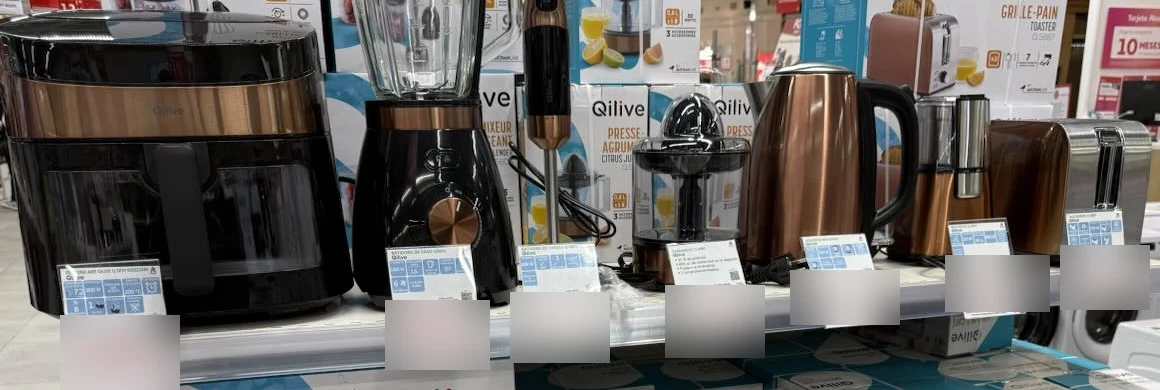
| Qilive | A matching black-and-copper range includes an air fryer, blender, hand blender, citrus juicer, kettle, grinder and toaster. | Can the colour, finish and packaging stay consistent across several categories? |
| Comelec | A glass-bowl air fryer makes the cooking chamber visible. | How easy are food monitoring, lifting and cleaning in everyday use? |
| Cecotec | Air fryers appear in the mixed-brand display, alongside single-drawer and twin-drawer formats. | Which format earns its space through a benefit shoppers can quickly understand? |
Qilive identifies itself as an Auchan group brand. Its coordinated display illustrates a practical private-label option: develop a recognisable collection across everyday kitchen tasks. [1] Separately, Cecotec's official range includes a stacked, two-basket model with viewing windows. That is a current catalogue example of format differentiation; the exact model in my store photograph is unconfirmed. [2]

Ninja and the wider European brand benchmark
A store visit captures one assortment. To build a European buying brief, I would also compare the following brands using their official regional ranges. These catalogue examples add context to the photographs.
| Brand and official product reference | Product focus | What I would assess when sourcing |
|---|---|---|
| Ninja — AF400EU | 9.5-litre air fryer with two independent baskets and synchronised finishing. | Whether two foods with different cooking times can be served together. |
| Philips — Airfryer 5000 Series | Dual-basket air frying. | Basket layout, everyday controls and the steps needed to prepare a complete meal. |
| Tefal — Dual Easy Fry & Grill | Air frying and grilling in a two-drawer format. | How well each cooking mode works in the same product. |
| De’Longhi — Rivelia | Automatic coffee preparation with interchangeable bean hoppers. | Drink consistency, cleaning and the ease of changing coffee beans. |
| Bosch — VitaPower | Countertop blending. | Blending results, jug handling and cleaning after repeated use. |
| Braun — MultiQuick | Hand-blender systems. | Grip, attachment changes and useful functions within a compact kit. |
| Dyson — V15 Detect | Cordless vacuum cleaning. | Cleaning results, handling and maintenance as a separate category brief. |
Ninja is a particularly useful air-fryer reference because its two-basket proposition addresses a familiar task: getting different parts of dinner ready together. My buying question is how reliably a competing product delivers that result. Capacity alone gives only part of the answer.
These comparisons suggest two practical briefs for China sourcing: products with a demonstrable cooking or cleaning benefit, and coordinated private-label collections built around everyday tasks. Both require repeatable sample results and clear instructions. The feature examples above are manufacturer descriptions; the assessment criteria are my interpretation.
2025 results: growth depends on the category
France offers a useful national indicator. GIFAM and NielsenIQ-GfK report small-appliance retail value growth of 2.9% in 2025. Air fryers grew 9.1%, compared with the 129% growth for 2024 cited in that same report. Wet-and-dry vacuum cleaners grew much faster. France provides evidence of category differences within Europe. [3]

| France: category | 2025 retail value growth |
|---|---|
| Wet-and-dry vacuum cleaners | +66% |
| Robot vacuum cleaners | +28% |
| Blenders | +16.6% |
| Air fryers | +9.1% |
| All small domestic appliances | +2.9% |
For kitchen buyers, my reading is that an air fryer now needs a stronger reason to replace an existing appliance. A useful viewing window, a workable basket layout or easier cleaning gives the buyer something concrete to evaluate. Blenders deserve their own assessment rather than being treated as a secondary line.
Europe's buying journey connects the shelf and the screen
NIQ's Western Europe outlook reports that online purchases represented 45% of small-appliance sales value in the first half of 2025. It also highlights stores' role in product trials, especially for premium purchases. Its October 2025 forecast put Western European small-appliance value growth at 5–7% for 2026, with France, Spain and Italy expected to be particularly active. This remains a dated forecast, separate from the 2025 actual results. [4]
A supplier's content should therefore answer the same questions as the physical display: how large is it, what fits inside, how does it work, and what needs cleaning? Short demonstrations and clear dimensions can make a product easier to compare across both channels.
China's exports: Europe is important, but categories move differently
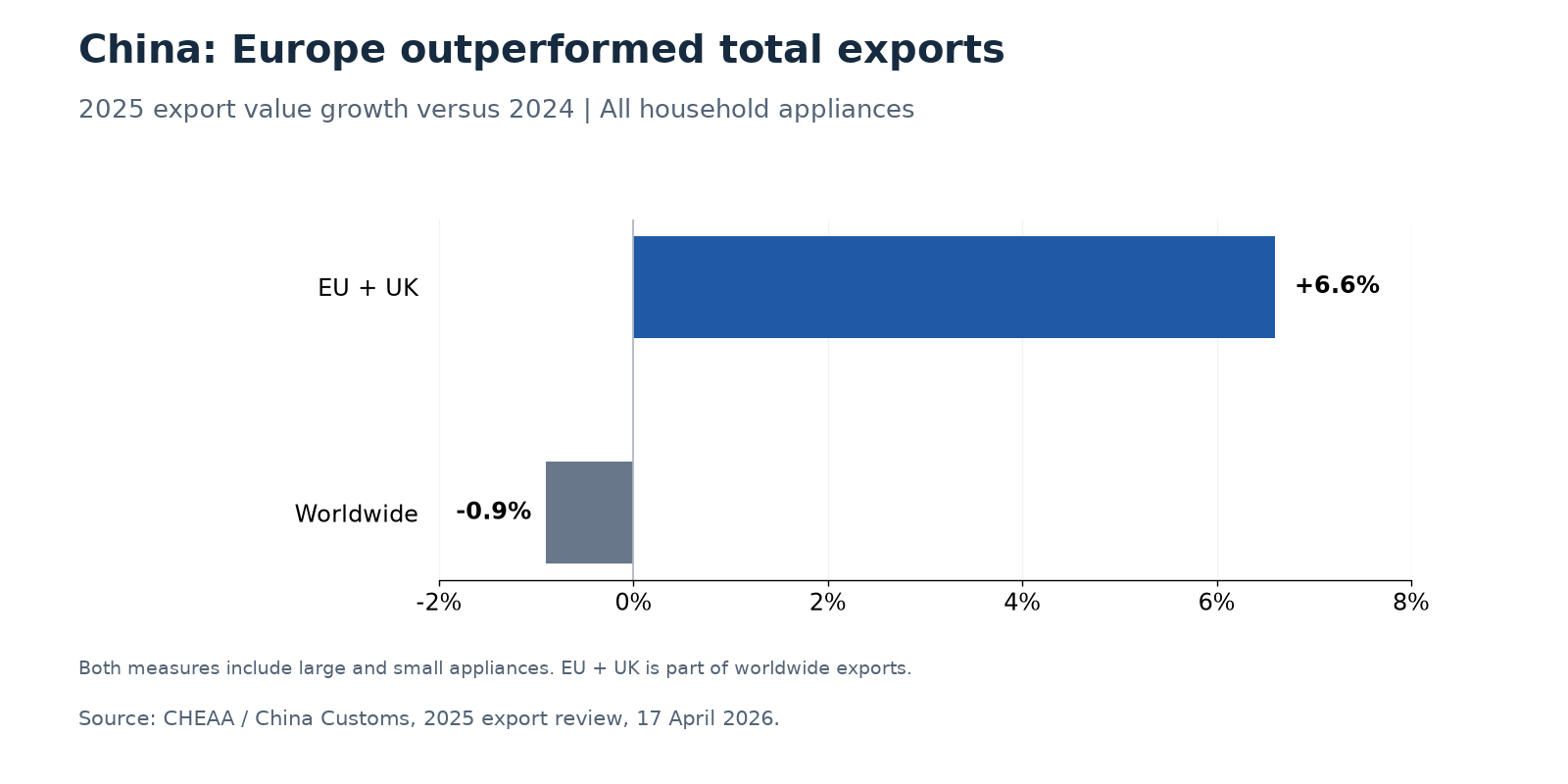
CHEAA's analysis of customs data puts China's 2025 appliance exports to the EU and UK at $26.36 billion, up 6.6%, while worldwide appliance exports fell 0.9% to $111.41 billion. These totals cover both large and small appliances. For individual small-appliance categories, worldwide vacuum-cleaner exports rose 8.8% to $7.10 billion; electric baking and grilling appliance exports were $5.88 billion, down about 10%. The latter is a broader customs category than air fryers. [5]
The latest verified update used here is January–June 2026: China's worldwide appliance exports reached $61.3 billion, up 3.4%. This is a half-year total for the whole appliance industry. [6]
The connection is commercially useful: stronger French cleaning sales and rising Chinese vacuum exports point in the same direction, while Europe's growing importance gives exporters a reason to refine their regional offer. Retail sales and shipments measure different stages of the supply chain, so I would use this alignment to shortlist categories, then check local sales and stock levels before placing an order.
How I would turn the findings into a buying plan
- Air fryers: compare usable basket space, food visibility and cleaning access through the same cooking demonstration.
- Coordinated kitchen ranges: approve physical colour and finish samples together, then check packaging consistency across the range.
- Blenders: compare jug capacity, controls and cleaning steps using the same ingredients and test conditions.
- Cleaning appliances: assess floor performance, maintenance time and the availability of replacement parts before expanding the assortment.
My main takeaway from Spain is that the shelf already offers plenty of choice. A convincing range needs a purpose shoppers can recognise and a specification buyers can verify. For China sourcing, the next step is a tighter product brief, supported by sample testing and a realistic replenishment plan.
Planning a European kitchen-appliance range? Discuss your product brief with Cheergrow.
Sources and scope
By Dustin. Store visit: 10 October 2026. Research checked: 14 October 2026. Photographs supplied by the author; selected crops preserve product appearance, with retail price labels blurred. Brand comparisons concern the photographed displays and cited catalogue features. The sourcing recommendations are the author's interpretation.
- Qilive: official brand FAQ.
- Cecotec: official DuoLevel 12000 Window product page, current catalogue checked 14 October 2026.
- GIFAM / NielsenIQ-GfK: French appliance market, 2025 results, 12 February 2026. Growth rates are those in this edition.
- NIQ: Home Appliances Outlook 2026 — Western Europe, 15 October 2025. Forecast and H1 2025 channel data.
- CHEAA Information & Consulting Department: 2025 export review, published by Electrical Appliances magazine, 17 April 2026; based on China Customs data.
- CHEAA: H1 2026 appliance export update, 27 July 2026; based on China Customs data.
Additional brand references are linked to official regional product pages in the comparison table, checked on 14 October 2026. They illustrate product approaches rather than market-share rankings. Geographies and product definitions follow each data source. The French retail figures, Western European outlook and Chinese export figures provide complementary signals, each interpreted within its original scope. Monetary figures in this article are US dollars.